
What’s the first thing you do when you wake up?
If you’re anything like me, the answer would probably be scrolling through your phone. Checking messages, and emails and going through the Instagram feed and whatnot!
Our devices have almost taken over our days, we consume more content in a day than our ancestors did the whole of their life! This content can be anything from images on Instagram, a blog article on the blockchain, a funny GIF, or even educational videos.
Amongst these videos is one of the widely used forms of content. Be it an ad on youtube, your favorite show on Netflix, or the product management course you’ve been following on Lynda.
Video for sales works wonders in engaging with your audience, building a relationship, and even teaching or learning something new. They are one of the simplest ways to get your message across.
In recent times, we’ve seen a proliferation in the choice of video platforms. Almost every niche has several video platforms dedicated to it. But content creators still strive to enter this market and generate some hard-earned revenue.
But the question remains, can selling videos online still be your source of income?
Yes, it can be. Let’s walk through how!
Sell your video online!
TABLE OF CONTENT
- Why is Youtube not a good platform for generating revenue through video?
- How can a premium video hosting platform help sell videos?
- 7 Steps To Sell Videos Online
- How To Sell Videos Online and Not Lose Any Revenue To Piracy
- Leakages that can be prevented by technologies and not legislation to Sell Videos Online
- How effective can DRM technology be in Selling Videos Online?
- What are the costs of the solutions in terms of technology, usability, and money to Sell Videos Online?
Why is Youtube not a good platform for generating revenue through video?
As an aspiring content creator, you might think that YouTube is the best platform for your needs. But, this might not be the case if you want to generate revenue from your videos.
The answer to this question lies in the subscription model of youtube. YouTube operates on AVOD, ad-based video-on-demand mode.
Youtube is not a good platform to sell videos online, especially if you are planning on a subscription-based model? Being one of the most used and common video streaming platforms, youtube provides videos for free. This increases its user base, and creators, therefore, prefer youtube for covering major audiences.
-
AVOD model
Due to the AVOD model, YouTubers or video creators on youtube get less share of video subscriptions. The youtube itself monetizes the ad-placement, thereby restricting YouTubers from choosing high paying ad-clients. This, as a result, lowers YouTubers’ incomes.
Even after getting various sales through or on their videos on youtube, creators get less share. Recently, even after millions of video views, most of the YouTuber’s pay remains bordered.
-
Low advertising pay
Youtube provides low advertising rates. This implies that even after getting ad-placements on videos and hundreds, thousands of views, their pay doesn’t elevate much. However, this is done by finding high-paid sponsors for their videos and promoting several brands.
-
Low CPM
Recently, in the COVID era, this was brought to notice by various video creators of youtube. Content creators reported that they were getting low CPM (cost per 1000 impressions). It was due to reduced ad-costing even though the video views jumped.
How can a premium video hosting platform help sell videos?
Just as in the real world, a shop’s physical appearance matters for the sales. Having a compatible video hosting solution can decide video for sales. Video monetization over different platforms can make a huge difference. One might get a prospect and convert an audience over one platform and not even get reasonable reach over another.
A premium video hosting platform can help you with:
- Encrypted video streaming to secure videos from piracy
- Improved privacy controls offering a better video sharing experience
- Real-time tracking and analysis of the user base of your audience
- Offer pre-determined bandwidth plans
- Reduces the video hosting expenses
- Allows you to publish and broadcast HD videos
- Increased conversion rate with improved audience engagement
Always keep in mind, the only monetization on the right video hosting platform can help you generate some revenue!
Explore More ✅
Sell Your Videos Online With VdoCipher’s Secure Video Hosting
VdoCipher helps several VOD and OTT Platforms host and sell their videos securely, helping them to boost their video revenues.
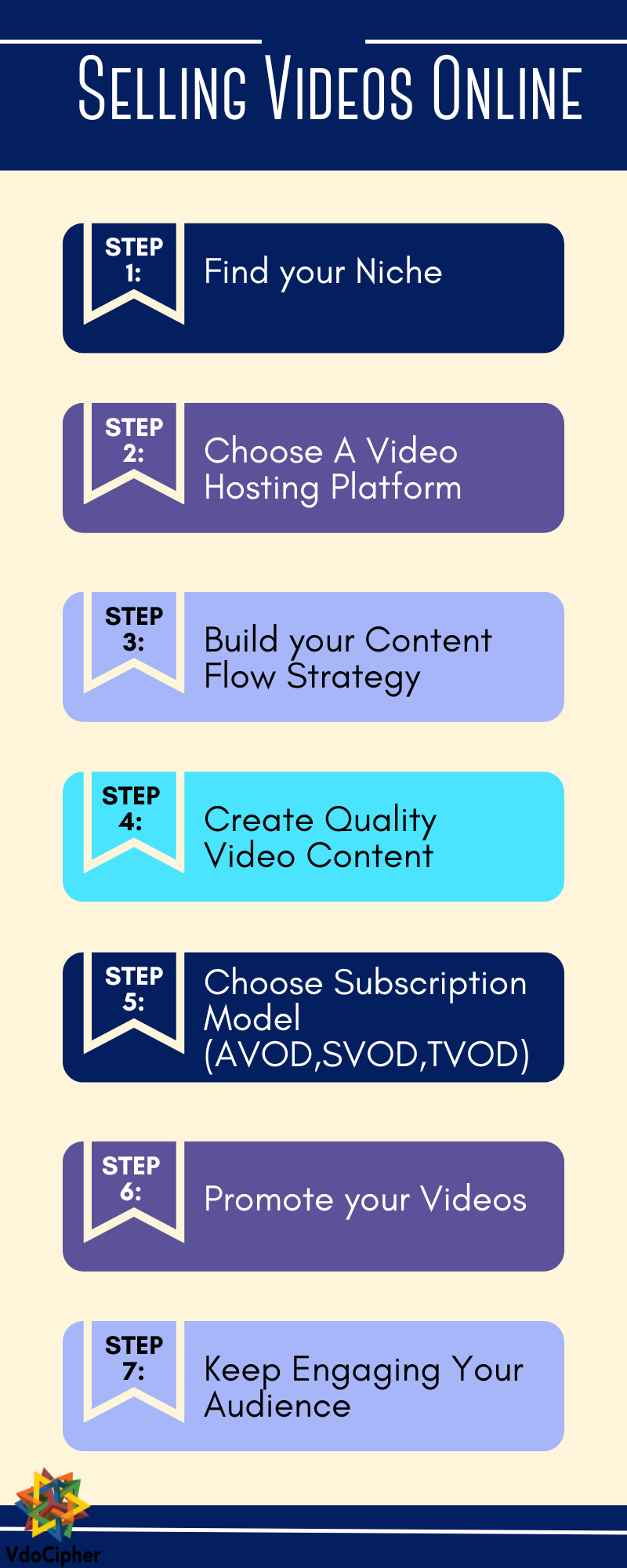
7 Steps To Sell Videos Online
To start, let’s quickly understand the steps to follow for video selling online-
- Finding your Niche
- Choosing the Right Video Platform
- Build your Content Flow Strategy
- Create Quality Videos
- Selecting a Subscription Model
- Promote your videos: Increasing traffic
- Audience engagement
Let’s get started:
-
Finding your niche
Finalizing your niche can decide the outcomes. Carefully list down the topics or video categories that interest you and come under your video creativity umbrella.
Your selected niche can and cannot have an audience on the platform. So, before making a firm decision on video niche, consider the following points-
- The customer base for that niche on various platforms.
- Audience engagement and behavior
- Fellow video creator’s content style and ideas
- Profit margins on a selected niche
Do intense market research about your niche and track audience engagement for the same niche’s fellow video creators. Study their content posting patterns, understand their videos, and explore. This way, you can serve users a feast of unique and innovative content that people feel worth paying for.
A comprehensive market understanding can forecast your audience retention rate as well. And if the market behaves as per the expectations, this can even give you an idea of content flow.
2. Choosing the right video hosting platform
Selling an ice-cream at a fashion store!
Sounds absurd, isn’t it!
Choosing the right type of business video hosting platform can bring catastrophic turns to your video-creating journey. There are immense options out there, waiting for video creators and offering attractive profit margins. But you need to curb your excitement and act pragmatically.
Always go through the user base of the platform thoroughly to understand and predict your target audience volume. This would save you tons of time and can also increase the probability of your success.
If your video ideas need certain functionality and features, consider them before actually starting delivering content. A test run of the short video might sometimes help to anticipate stats and market behavior.
Money! Money!
Selling videos online is for money (we all know this, honestly). Go through the paying members of video platforms. It would give you an idea about how many prospects paying customers your content can get. Also, how much you can earn in real figures.
Another important thing you need to consider is protection from video piracy. A lot of businesses lose revenue due to this. The best way to safeguard yourself from this is to opt for a secure video hosting service with a multi DRM set up along with other important security features such as screen recording protection, domain whitelisting, etc.
3. Build your content flow strategy
As soon as you finalize a niche and are ready with rough notes on market behavior, plan a content calendar.
Yes, don’t follow an impromptu approach. As you plan to get paid for your videos, a keen and efficient content strategy is needed. Plan your content around a selected platform and niche.
Study audience content-consuming patterns, shortlist your most engaging hours and try to strategize accordingly. Consistently deliver value in your content.
No doubt that your content can be of any type. It can be one long video. A series of videos can be a web course or a video followed by an e-book purchase. Deliver something your competitor has missed.
Deliver what your target audience would most connect with.Whether you’re showcasing captivating visuals, informative content, or a combination of both, consider the appeal of personalized photo books to enhance engagement. And if necessary, plan discounts, coupons, and special gifts for your audience for increasing retention and participation. Make sure to check out platforms such as Karma to keep up with pricing drops and coupons.
If you want to know more about this topic, you can refer to our article in elearning video production
They have paid for your video content, and they should get real benefits.
4. Create Quality Videos
No matter how well you investigate your target audience, platform, and niche, the final deciding factor for your video’s success will be your “content.”
Always test and check videos for three factors; uniqueness, quality, and value.
Take these three factors parallel and equally important. For a beginner, there might be a case that you lag on these factors but learn from observing. Observe other creators, watch content and implement and improvise your content strategy. And if you want to sell your eCommerce product, prioritize design as well, and use Shopify Themes to give your brand a great image.
One might not feel confident in editing videos. Hence, collaborate with some professional video editors to deliver interesting and engaging videos in the starting for user retention.
The uniqueness and value also depend on the type of content and niche. For instance, If you provide educational content, adding an animation can attract eyeballs. Delivering culinary or recipe videos, live streaming, and real videos would also help. Here is a few eLearning video software to help you create quality videos.
Consider the following tips:
-
Structured Curriculum: Organize content into modules or chapters for easy navigation.
-
Interactive Elements: Incorporate quizzes, assignments, or discussion forums to enhance learning.
-
Quality Production: Use good lighting, clear audio, and high-resolution video to maintain professionalism.
-
Supplementary Materials: Provide downloadable resources like PDFs, slides, or worksheets to complement the video content.
Always remember, observe, learn and implement.
5. Selecting a subscription model
You finalized a niche, selected a video hosting platform, prepared content, and uploaded it. Now what?
How would your customers access your content? Will it be on a pre-payment basis? Or would you like to provide the first few videos for free and then introduce a subscription model?
There are models available on video platforms to handle payment modes:
- SVOD- Subscription video on demand.
SVOD model works on a subscription basis, and users can watch videos until their subscription is valid and active. However, once the subscription ends, the content becomes unavailable.
This presents a challenge for content creators to keep the audience’s interest continuous before their subscription ends. It would make users renew their plan, and boom, you get a continuous audience for your content.
This model is ideal for businesses with a dedicated audience who are willing to pay for excellent content.
The market potential for Subscription video on demand model is global in scale. It is a highly competitive landscape where one should be able to adapt with new technologies and content.
SVoD businesses can leverage OTT platforms like Apple TV, Amazon Fire TV eliminating the need for a set-top payment box providing more flexibility to the users. It provides a way for consumers to pay for the content they would love to see.
Popular Platforms of the SVOD model are Netflix, Disney+ and Amazon Prime Video.
- TVOD- Transactional video on demand
TVOD mode presents users with a one-time payment for continuous access to the content. This generally also includes DTR, download to rent mode granting access for the specific time for specified fees.
Subcategories of TVoD are:
- Electronic Sell-Through (EST) – One time payment for permanent access to a content
- Download to Rent (DTR) – Access to a content for a limited period time with a smaller fee
The TVOD model is perfect for businesses looking to sell specific niche videos. Example: An Educational company selling online courses .
Popular Platforms of the TVOD model are Google Play, Udemy and iTunes.
- AVOD- Ad-based video on demand
The popular video streaming platform; youtube runs on the AVOD model. It gives platforms control over video monetization and pays creators based on ad-placement, whereas the content stays free for users.
This model yields less revenue for creators and is often not preferred by video creators.
Publishers will be paid based on the 1000 ad impressions. It is necessary to attract a lot of people to this platform to make revenue. This model suits the platforms like YouTube, Vimeo where they generate revenue through advertising.
This model is applicable on mobile devices, websites, apps.There are two types of AVOD model to choose from: Programmatic and direct-sold advertising.
This model can go wrong if too many ads are served to the audience causing the user experience. This model yields less revenue for creators and is often not preferred by video creators.
Popular Platforms of the AVOD model are YouTube and DailyMotion. Read out detailed blog on SVOD vs TVOD vs AVOD
There’s no one-size-fits-all. Pick what aligns with your content and audience:
| Model | Best For | Examples |
|---|---|---|
| TVOD (one-time payment) | Masterclasses, short series | “Mastering Premiere Pro in 10 Days” |
| SVOD (subscription) | Ongoing tutorials, community content | “Monthly Drawing Challenges” |
| PPV (Pay-per-view) | Event-based or live replays | “Live Music Production Workshop” |
| Bundles & Tiers | Product packages or upsells | “Buy 3 courses, get 1 free” |
| Freemium | Tease content, upsell full course | Free intro lesson + paid full series |
Read more: What’s the difference between SVOD and AVOD.
6. Promote your videos: Increasing traffic
Make your content reach the right audience.
Marketing your content is important and a deciding feature for your videos’ success. An overnight reach and engagement of 100,000 is a myth. One needs constant promotion, marketing with the content.
Your marketing strategy can design around the residence of your target market. In that matter, it’s a great idea to start working with a digital agency that can help you successfully promote your videos on social media channels.
One can also promote content with other video creators and social media influencers for creating a starting demand. So, if you are not sure how to do it, you can always reach out to a social media influencer agency to get some aid. If you are looking for an official and more professional audience, use e-mail marketing and plan email content cautiously. Because the user’s spam box should not be your destination. In this process, a good SPF checker can help authenticate your emails and send message in a more secure way.
We are talking about video content marketing. Private video hosting platforms can surely help. One can also collaborate with famous YouTubers with a hefty number of subscribers to get enough word of mouth word.
But there is no thumb rule of marketing here. Use diverse channels to market and promote your content actively. These diverse channels can be the following :
-
Email Marketing: Build an email list to inform subscribers about new courses, promotions, or updates.
-
Social Media Promotion: Utilize platforms like Instagram, LinkedIn, or YouTube to showcase snippets of your courses and engage with your audience.
-
Content Marketing: Create blogs, podcasts, or webinars related to your course topics to establish authority and drive traffic.
-
Affiliate Programs: Collaborate with influencers or affiliates who can promote your courses to a broader audience.
- Social Proof: Testimonials, ratings, and student shoutouts
-
Paid Ads: Use Facebook/Google ads for retargeting and cold outreach
7. Audience engagement
Establish a real relationship with your audience instead of just interacting on-screen. Word-of-mouth can be your best branding.
Interact and engage with your customers regularly. Host virtual events, virtual meet-ups with a bunch of users, take feedback. Feel them attended and entertained. Provide customized plans if possible.
Despite only having a screen and virtual connection with an audience, engage with them. One can also create polls for their channels. This can also be used to create buzz for upcoming content videos.
A real user always trusts fellow users. Publish testimonials and customer reviews; some negative reviews would also not harm anyone. Just show your real side to the users.
Regularly assess your courses’ performance to identify areas for improvement. Utilize analytics tools to monitor:
-
Watch time & drop-off points: See which lessons need fixing
-
Sales analytics: Know what sells best
-
A/B testing: Try different headlines, thumbnails, and prices
-
Feedback loops: Survey your students regularly
8. Secure & Deliver Seamlessly
Your content should be easy to access — and hard to pirate.
-
DRM encryption & watermarking: Stop downloads and screen captures (VdoCipher, SVP)
-
Geo/domain restrictions: Limit who can access your content
-
Mobile & smart TV apps: White-labeled apps
-
Buffer-free hosting: Ensure fast, global delivery via CDNs
Don’t let tech glitches ruin your customer’s first impression.
How To Sell Videos Online and Not Lose Any Revenue To Piracy
Media publishers trying to sell videos online have often heard “ Once you have put your videos online, it is free . There can be no DRM on the internet”. How practical is this argument and are there ways to prevent video download on the web?
The first infographic is an excellent illustration of the means through which paid content reaches the end viewers. It includes both legal methods as well as the path adopted by pirates.
It is shocking to see how premium content is able to reach all over the world for free. The circle of warez , torrent and linkers is the primary culprit for this online piracy.
As we move away from the center, the number of branches distributing the content for free increases exponentially. SOPA (Stop Online Piracy Act) has been proposed as a solution to the problem . Instead of trying to prevent stealing of premium content from initial release points, SOPA tries to disarm the websites which have the ability to redistribute this release.
It targets subsequent circles of seeders, uploaders and downloaders which comprise the general internet users. This circle is the nerve of the internet. Trying to restrict it would mean to undo the openness, which the worldwide web has brought into the world.
Another infographic discusses the numbers relating to the online video market and piracy. Let’s reflect upon how much a video DRM can affect this scenario. There are encryption & authentication technologies adopted by the video hosting companies that are evolving over time.
The videos hosted through these technologies can’t be downloaded on the web. Their idea is to make downloading so difficult that users would find the effort of downloading to be much exhausting, and ultimately pay for the video.
Leakages that can be prevented by technologies and not legislation to Sell Videos Online
As seen in the first picture, the loss of video content from the release groups and paying users has to be targeted. Let’s consider the movie and e-learning industries which are looking to sell videos online.
The paid users are the starting point of piracy. One subscriber pays for the video. He downloads it using one of the freely available downloaders. Then, he shares it among his circles or puts it online.
This allows everyone to enjoy premium quality content at no costs. Most of the CDNs and online video hosting companies with DRM try to plug these holes.
How effective can DRM technology be in Selling Videos Online?
Looking at the second picture, one can see that in the USA 70% of the pirates are of age 18-29. The number of copy-right infringement notices given to colleges is a clear indication of how students are able to access and enjoy free content.
Most premium content is available at affordable costs, but it is so easy to get it free that no one even pays the actual amount. This has led to a great loss to online TVs , tutorial teachers and movie sellers.
The security-based on encrypted video streaming and authentication is an effective solution to this problem. These DRM technologies prevent download from any such downloader on the web. This restricts online and offline sharing of content.
Another means to prevent video piracy is dynamic watermarking. Watermarking the videos with information of the subscribed user is an effective means to restrict uncontrolled distribution of videos. To know more about video piracy and how to stop it, you can refer to the blog linked.
How Much Does It Cost to Sell Videos Online?
Selling videos online costs between $0 and roughly $200 a month in platform fees, plus 0–10% of each sale in transaction fees, plus payment-processing charges of about 2.9% + $0.30 per transaction. The cheapest route — Payhip or Gumroad’s free tier — costs nothing until you make a sale. A full subscription platform with TV apps starts around $149/mo.
Listing those numbers separately hides the thing that actually decides your platform choice, which is how the two interact. A 10% transaction fee is free when you are selling nothing and ruinous at scale; a $179 subscription is the reverse. So model your real monthly revenue, not the sticker price.
Four costs people forget
- Payment processing. Roughly 2.9% + $0.30 per transaction, charged on top of any platform fee. Every platform in this guide passes it through.
- Bandwidth and storage. Included on most course platforms up to a cap, then metered. Video is heavy — a 60-minute HD course streamed 1,000 times moves serious data.
- Tax handling. EU VAT and similar digital-services taxes apply to your buyers’ locations, not yours. Some platforms handle this; some leave it to you.
- Refunds and chargebacks. Chargeback fees are typically $15–$25 each and you keep paying them even when you win the dispute.
Worked example: $2,000 a month in sales
Take a creator selling forty $50 videos a month. On Gumroad’s free plan, the 10% fee plus processing costs about $258 — no monthly bill, but a real bite. On Thinkific at $49/mo with 0% transaction fees, processing alone runs about $70, so the total is $119. Thinkific is less than half the cost at this volume, and the crossover point is lower than most people expect: around $700–$800 a month in sales, a paid platform with no transaction fee starts winning.
Worked example: $200 a month in sales
The same maths inverts at the bottom. Four $50 sales on Payhip’s free tier costs about $17 in combined fees. On Uscreen it costs $149 plus processing, which is most of your revenue. Start free, move when the arithmetic says so — and re-run it every few months, because these prices change.
How Much Money Can You Make Selling Videos Online?
Direct video sales earn far more per viewer than advertising. YouTube pays roughly $3–$5 per 1,000 views, while a single video priced at $29–$99 can earn the same amount from a handful of buyers. In practice, a creator with a 1,000-person email list converts 1–3% on a first launch — 10 to 30 sales — and established subscription video businesses commonly reach $10,000–$12,000 a month once their catalogue passes 25 videos.
The per-view comparison is stark enough to be worth stating plainly. One hundred thousand YouTube views might return $300–$500. The same audience, converting at a modest 1% on a $49 product, returns $49,000. That gap is why creators move off ad revenue — not because YouTube is bad at distribution, but because ad rates value a viewer at a fraction of a cent while a buyer values them at $49.
Realistic monthly earnings by model
| Model | Typical monthly range | What drives it |
|---|---|---|
| Donations / tips | $300–$1,600 | Audience loyalty; no catalogue needed |
| One-off sales (TVOD) | $1,000–$10,000 | Launch-driven and spiky |
| Subscription (SVOD) | ~$12,000 | Catalogue depth and low churn |
| Membership + community | $12,000+ | Retention; community reduces churn |
The honest caveat
Those numbers describe creators who already have an audience, and it would be misleading to present them as typical outcomes. More than half of all creators earn under $15,000 a year. The single strongest predictor of a successful first launch is not video quality or platform choice — it is whether you have an email list before you have a product. If you do not, build that first; the platform decision can wait a month and will be easier to make once you know who is buying.
Which Platform Should You Choose?
Four questions get you to an answer. Work through them in order — the first one eliminates the most options.
1. How many videos do you have?
Under 10 videos, sell them individually and do not build a subscription — there is not enough content to justify a recurring charge, and churn will be brutal. Between 10 and 25, one-off sales or bundles still work best. Past 25 videos with new content arriving regularly, a subscription becomes the better business: predictable revenue and a rising lifetime value per customer.
2. Is it a course or a catalogue?
A course has an order — module one before module two, a quiz, a certificate at the end. That points to Thinkific or Teachable. A catalogue is browsed, not completed: viewers pick what they want on a given day, the way they use Netflix. That points to Uscreen or Muvi. Choosing the wrong shape here is the most common expensive mistake, because migrating a catalogue out of a course platform later is genuinely painful.
3. Do you need your own website?
If you already have a site with traffic and rankings, sell from it — you keep the SEO value and the customer relationship. Pair WordPress with WooCommerce or Easy Digital Downloads and a dedicated video host. If you have no site and no appetite to run one, a hosted platform is the faster path, and you can always migrate later.
4. What would one leaked copy cost you?
This is the question most guides skip. If your content is a $19 tutorial, piracy is an annoyance and download-disabling is enough. If it is a $499 certification course, a three-year subscription library, or exam-prep material in a market where pirated copies circulate on Telegram within hours, then the video layer needs real DRM — and no course or storefront platform on this list provides it. That is where VdoCipher fits: keep your storefront, replace the video hosting underneath it.
How to Price Your Videos and Courses?
Price follows the outcome you deliver, not the minutes of footage you recorded. A 20-minute video that helps someone pass a licensing exam is worth more than a six-hour course that teaches a hobby, and buyers price it that way even when creators do not. Start from what changes for the viewer after watching, then check that against the bands below.
| Product | Typical price | When it fits |
|---|---|---|
| Single video or mini-course | $19–$49 | One specific skill or problem solved |
| Full course or bundle | $99–$499 | A complete outcome — a qualification, a portfolio piece |
| Premium cohort or coaching | $499–$2,500+ | Live access, feedback, accountability |
| Monthly subscription (general) | $19–$49 | Broad-interest catalogue, weekly additions |
| Monthly subscription (specialist) | $49–$99 | Professional or career-critical content |
How much should you charge for a one-hour video?
Between $10 and $50 for most standalone content, and toward the top of that range when the hour solves an expensive problem. Length is the weakest input into the decision — a tightly-edited 40 minutes that gets someone to a result outsells a rambling 90 minutes at the same price, every time.
Three pricing decisions that matter more than the number
- Annual plans. Offer one at roughly ten months’ cost. It improves cash flow immediately and cuts churn, which is the metric that actually determines whether a subscription business works.
- Do not launch cheap to “test demand.” A low price attracts the buyers least likely to finish and most likely to refund, and raising prices later annoys everyone who bought early. Launch at the price you want and discount deliberately.
- Bundle rather than discount. Adding a workbook, a template pack or a community invitation raises perceived value without teaching your audience to wait for a sale.
How to Sell Videos on Your Own Website
Selling from your own site gives you the best margin and the whole customer relationship — no platform cut, your own email list, your own SEO. The trade-off is that you assemble the stack yourself. It has four layers, and mixing them up is where most self-hosted setups go wrong.
The four layers
- The site. WordPress in most cases, because the plugin ecosystem for this is unmatched.
- The checkout. WooCommerce or Easy Digital Downloads for one-off sales; a membership plugin such as ARMember or MemberPress for recurring access; LearnDash if you need course structure. Stripe, Paddle or Lemon Squeezy sit behind whichever you pick — Paddle and Lemon Squeezy act as merchant of record and handle international tax for you.
- The video hosting. A dedicated video host, always.
- The access control. Whatever ties a paid order to the videos it unlocks.
Never upload your videos into WordPress
This is the single most common and most expensive mistake in self-hosted video selling. Uploading MP4s to your own server means your web host serves the video, which will quietly wreck your page speed, fail under concurrent viewers, and hand every buyer a directly downloadable file URL. You have then paid for a paywall that anyone can walk around by opening the browser inspector.
Use a dedicated video host and embed the player. Your server serves the page; the video host serves the stream, adapts the quality to the viewer’s connection, and controls access to the file itself.
What a secure embed needs to do
- Encrypt the stream so the file cannot be lifted out of the page by a download manager or browser extension.
- Restrict playback to your domain so a copied embed code does not work on someone else’s site.
- Issue short-lived, signed playback tokens so a shared video URL expires instead of circulating.
- Watermark dynamically with the viewer’s email or user ID, so a screen recording can be traced to the account that made it.
How to Sell Videos Online Without a Website?
You do not need a website to start selling videos. Every platform in this category gives you a hosted checkout page and a link you can share, which is enough to make your first sale this week.
- Payhip or Gumroad — upload, price, share the link. No monthly fee; fees come out of each sale. The fastest possible start.
- Patreon — monthly membership in exchange for access to exclusive content. Best when you already have an audience that wants to support you rather than buy a specific thing. Verify current fee tiers
- Amazon Prime Video Direct — puts long-form content in front of Amazon’s audience. Real reach, but you accept their terms, their pricing structure and no direct customer relationship.
- Udemy — genuine course discovery, but it takes around 63% of sales it originates. Treat it as a marketing channel that pays a little, not as your business.
The trade-off to go in knowing
Marketplaces bring the audience and keep the customer. You get discovery you could not buy, and in exchange you usually cannot email your buyers, cannot control pricing fully, and cannot move them anywhere if the platform’s terms change. Storefronts like Payhip are the opposite: no discovery at all, but the buyer is yours.
A reasonable pattern is to use both — a marketplace for reach, your own storefront for margin, and a deliberate path moving people from the first to the second.
What are the costs of the solutions in terms of technology, usability, and money to Sell Videos Online?
There are no overhead costs of these technologies in terms of bandwidth or other network resources. The underlying innovation itself is the prized commodity.
The quality of streaming can be easily maintained at par with any regular streaming. End-users can access the content without installing any software on their desktops. Apps are available to ensure mobile compatibility along with security.
With more and more companies coming up with innovative DRM systems customized for markets like media and e-learning, there is a hope that premium video content creators would be able to monetize their potential.
Wrapping Up
The best way to sell videos online is to strategize every aspect of video creation to promotion. You need to make sure that there are no bottlenecks that stop you from selling videos online.
Make sure to study your competitors and learn from both their strengths and weaknesses. Understand your audiences and how they interact with the content. Also, you need to identify your USP, that is what separates you from your competitors and why exactly should someone pay for your content. Generally, content marketing is taking over new heights and well-formed content marketing service for SaaS companies, e-commerce, tech, and others now has high significance.
Another important point to be noted down is the protection from video piracy. You don’t want to put so much effort into video creation and promotion only the video to end up on piracy channels. Investing in secure video hosting would be the right thing to do. Just pick any with a multi DRM system and you should be good.
That’s all from my end, feel free to give a shoutout to this blog on your favorite social media platform!
Secure Your Videos from Download & Piracy
At VdoCipher we maintain the strongest content protection for videos. We also work extremely hard to deliver the best viewer experience. We'd love to hear from you, and help boost your video streaming business.


Rahul Rana is Head of Marketing at VdoCipher Media Solutions, where he educates users about video streaming and media technologies. He writes about video streaming, live delivery, DRM, and building custom video players to help developers and teams learn practical techniques. Rahul enjoys breaking down complex media tech into clear, easy-to-understand guides and insights.