
In the United Kingdom alone, an estimated 3.7 million unique IP addresses watched the 2026 Champions League final through illegal streams, a figure analysts suggest could represent as many as 16.2 million actual viewings. Not one of them showed up in a rights holder’s subscriber count.
Live sports piracy at that scale is not a fringe of determined freeloaders. Research across ten markets found that 51% of sports fans watch pirated content at least once a month, and the detail that should worry every broadcaster is that 89% of them already pay for a legitimate subscription. They are not refusing to pay. They are paying and still not getting the game.
Live sports piracy behaves nothing like film piracy. A leaked film is still worth protecting next week; a leaked match is worthless the moment the whistle goes. That single difference breaks most of the legal machinery built to stop it.
This article covers what live sports piracy actually is, how a stream travels from the stadium to a pirate site, who profits at each stage, and which sports and which regions lose the most money to it.
TL;DR
- Live sports piracy is the unauthorised capture and redistribution of a sporting event while it is being broadcast: a different problem from film piracy, because the content loses nearly all its value the moment the match ends.
- Football is the most pirated sport in the world, and the gateway for 48% of people who admit to watching illegal streams. Cricket is second, and first in India.
- The most-quoted global figure is $28 billion a year, from a joint NFL, NBA and UFC submission; but the credible per-league numbers are smaller and more useful.
- Combat sports suffer the worst damage per event. One heavyweight title fight reportedly drew 20 million illegal views and around $100 million in lost pay-per-view buys.
- Enforcement is a cleanup operation, not a real-time defence. The controls that work inside the match are the ones built into the stream itself.
Table of Content:
- What is live sports piracy?
- Why live sports piracy demands real-time protection
- 18 ways a live sports stream gets pirated
- How live sports pirates make money
- Which sports lose the most revenue to piracy?
- How piracy affects different sports
- Live sports piracy around the globe
- Why sports fans turn to pirate streams
- The hidden risks of illegal streams
- The wider economic cost
- How live sports piracy is being fought
- What this means for rights holders
- Frequently asked questions
What Is Live Sports Piracy?
Live sports piracy is the unauthorised capture and redistribution of a live sporting event while it is being broadcast. It covers illegal IPTV subscription services, rogue streaming websites, restreams on social platforms, tampered set-top boxes and stolen credentials; anything that delivers the live feed to someone who has not paid the rights holder for it.
The word “piracy” makes it sound like one activity. It isn’t. A teenager restreaming a match to a Discord server and a syndicate running 10,000 channels to 64,000 paying subscribers are both committing copyright infringement, but they are different businesses with different economics, and they need completely different countermeasures.
It is also, right now, the fastest-growing segment of digital piracy. Film and television piracy has been fought for twenty-five years and is broadly understood. Live sport is newer as a mass streaming product, far more valuable per minute, and structurally much harder to defend.
Why Live Sports Piracy Demands Real-Time Protection
A pirated film is still worth something on Monday. A pirated match is worth almost nothing once the final whistle goes.
This single fact shapes everything else. Standard copyright remedies, such as damages, recovering profits, taking back illegal copies, and stopping further distribution, work best when the original work still has value after it has been infringed. They work well, for example, when a film leaks on Friday and continues to have commercial value afterward.
Live sport concentrates its entire monetary value into the window in which the result of the match is unknown. A ninety-minute football match. A three-hour T20 innings. A twelve-round title fight that might end in ninety seconds. Once that window closes, the audience is gone and so is the point of most legal remedies.
That has three consequences that shape the whole problem:
- Takedown speed matters more than takedown certainty. A stream removed at full time was never removed in any meaningful sense.
- Pirates only need to survive for hours, not months. A domain registered on Friday and burned on Sunday has already done its job. This is why blocking produces mirrors within minutes rather than deterrence.
- Prevention outperforms enforcement. Preventive measures such as encryption, tokens, watermark attribution, hacker identification, and session limits are the only ones fast enough to matter during play.
A pirate stream does not need to be good. It needs to be live.
18 Ways a Live Sports Stream Gets Pirated
Most explanations of live sports piracy stop at “someone records the stream and puts it online.” In reality, the piracy supply chain usually has four stages. Understanding where an attack happens also helps identify the right way to stop it.
Stage 1. Acquisition: Stealing the Live Feed
The first step is getting access to the original or legitimate stream. That access can be taken at the source, before the feed reaches any viewer, or at the client end, by attacking the app or the account of a legitimate subscriber.
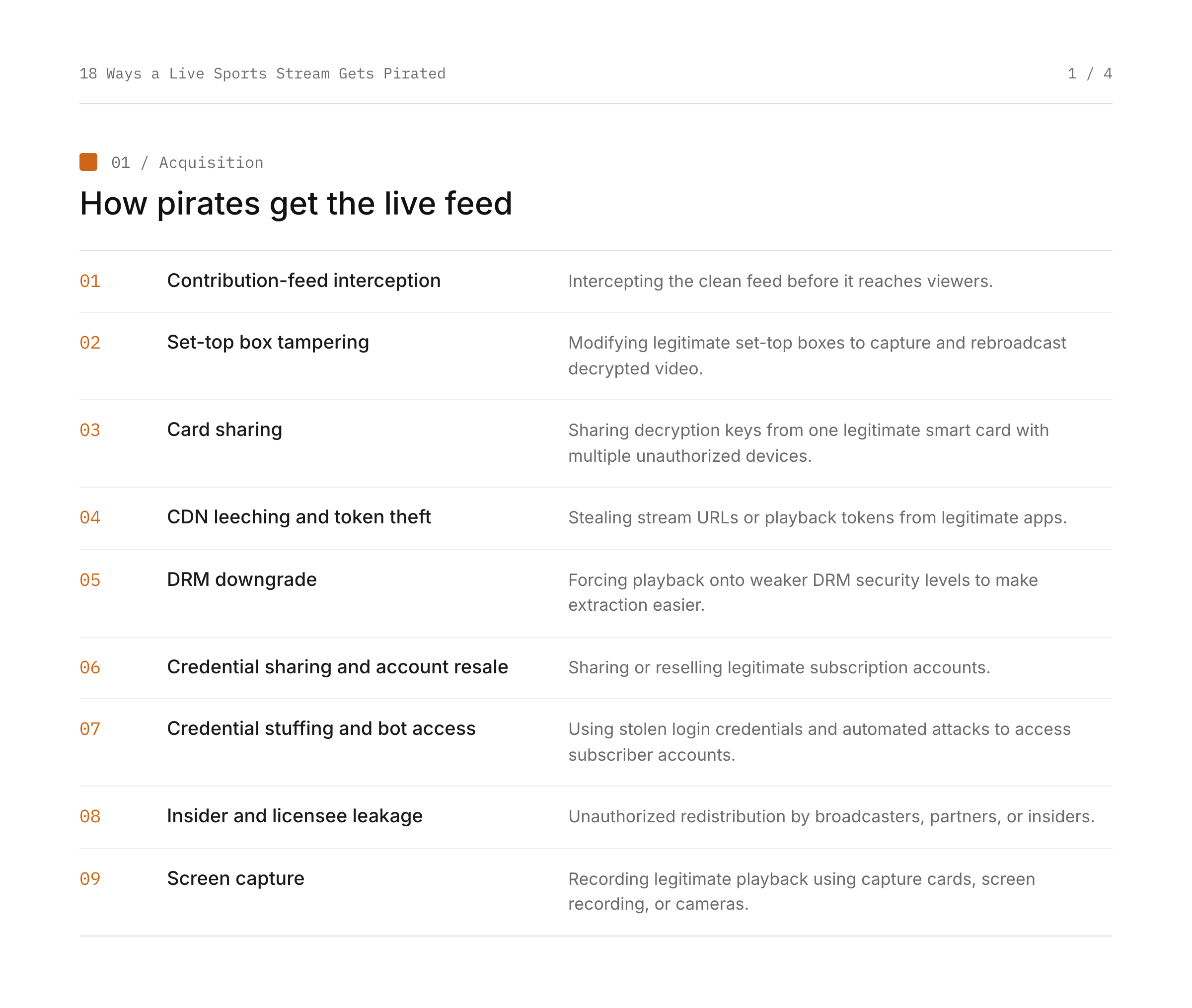
1. Contribution-feed interception
Pirates can intercept the clean feed travelling from the venue to the broadcaster’s playout system, often through an insider or an insecure teleport.
This is one of the most damaging leaks available, because the feed may carry no watermark, no broadcast graphics, and no broadcast delay.
How to counter it: Encrypt the contribution feed, rotate session keys, and apply a forensic watermark at the encoder rather than further downstream.
2. Set-top box tampering
Pirates can buy legitimate DTH set-top boxes and modify them to bypass content protection. The decoded video is then captured and rebroadcast online.
Several large IPTV operations in India have used this method to source premium television channels. A related problem is cross-border smuggling: activated Indian DTH boxes have been moved into neighbouring markets, and one seizure in the UAE recovered boxes carrying more than 12,000 pirated channels.
How to counter it: Pair boxes to secure chipsets, require identity verification at activation, and use renewable conditional access so compromised boxes can be disabled.
3. Card sharing
A legitimate smart card can be used to obtain decryption keys and share them in real time with thousands of unauthorised set-top boxes.
Card sharing has existed for decades, but it is still used in satellite television markets.
How to counter it: Pair control words to individual devices, rotate keys frequently, and monitor entitlement requests for abnormal patterns.
4. CDN leeching and token theft
Pirates can reverse-engineer a legitimate streaming app and extract its stream URL and access token.
The stolen link or token can then be shared with other viewers. In some cases, the rights holder’s own CDN ends up delivering the pirated stream and paying the bandwidth cost.
How to counter it: Issue short-lived, single-use signed playback URLs, bind each session to an IP address, and shield the origin server.
5. DRM downgrade
Pirates may try to force playback onto a weaker software security level, such as Widevine L3 instead of Widevine L1.
A weaker security environment can make it easier to extract encryption keys and capture the decrypted video.
How to counter it: Require hardware-backed DRM for live sport, and refuse software-level licences on premium tiers.
6. Credential sharing and account resale
A legitimate subscription can be shared with dozens of viewers, or sold wholesale through messaging platforms.
This traffic is difficult to identify because it looks like normal subscriber activity. The account is real and the payment is real; only the pattern of use gives it away.
How to counter it: Cap simultaneous sessions, limit registered devices per account, and score accounts for abnormal behaviour.
7. Credential stuffing and bot access
Pirates can also use leaked username and password databases to run automated login attempts against a broadcaster’s own app, then resell the accounts that work.
This is an attack on the login system itself rather than on the video, which means concurrency limits alone will not stop it.
How to counter it: Deploy bot defence at the authentication layer, apply rate limiting, and require multi-factor authentication on high-value tiers.
8. Insider and licensee leakage
A licensed broadcaster or distribution partner in a lower-cost territory may redistribute the feed into a market where it holds no rights.
This becomes much harder to control when a single event has dozens of regional licensees. A rights map with forty partners has forty possible leak points.
How to counter it: Give each licensee a different watermark variant, and write anti-piracy obligations directly into the rights agreement.
9. Screen capture
Pirates can also capture the video directly from a legitimate screen using a capture card or even a phone camera.
The quality may be lower, but encryption cannot completely prevent this type of copying. The main defence is being able to identify where the leaked stream came from.
How to counter it: Use a forensic watermark that survives re-encoding and camera capture, and block screen recording on platforms that allow it.
Stage 2. Processing: Preparing the Stolen Stream
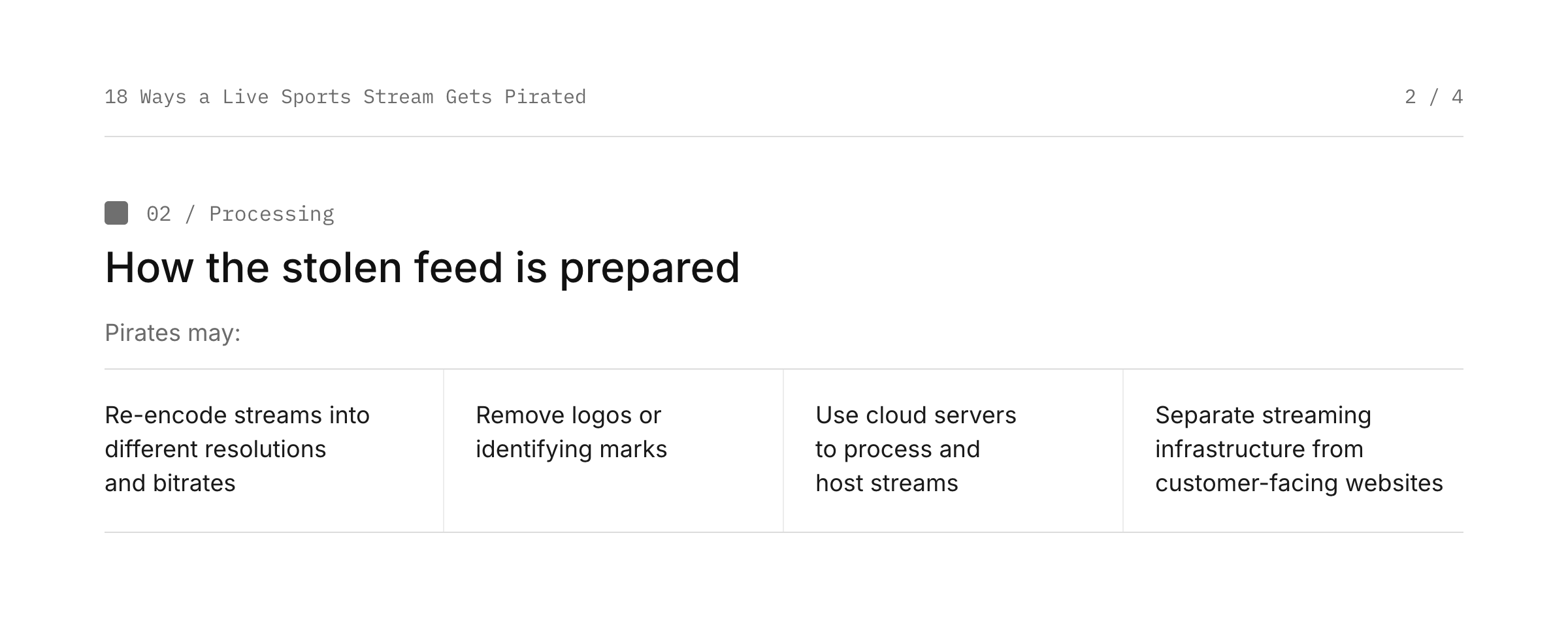
Once pirates obtain the feed, they prepare it for redistribution.
The stolen stream is usually re-encoded into multiple resolutions and bitrates so that it can work across different devices and internet speeds. Pirates may also remove logos, watermarks or other identifying graphics before sending the stream to their own distribution servers.
More organised piracy networks often use commercial cloud infrastructure to run these systems, and may place servers in countries where enforcement is more difficult. Sophisticated operations also separate the servers hosting the video from the websites or apps used by customers.
Europol reported this type of setup in its 2026 investigations. Customer-facing websites were separated from the servers hosting the pirated content, while infrastructure was spread across several countries. This made it harder for a court order in one country to shut down the entire operation.
There are no numbered attacks in this stage, because nothing is being stolen here. It is the step that turns a stolen feed into a saleable product, and it is the step enforcement almost never reaches.
Stage 3. Distribution: Getting the Stream to Viewers
Once the stream has been prepared, pirates need a way to reach viewers.
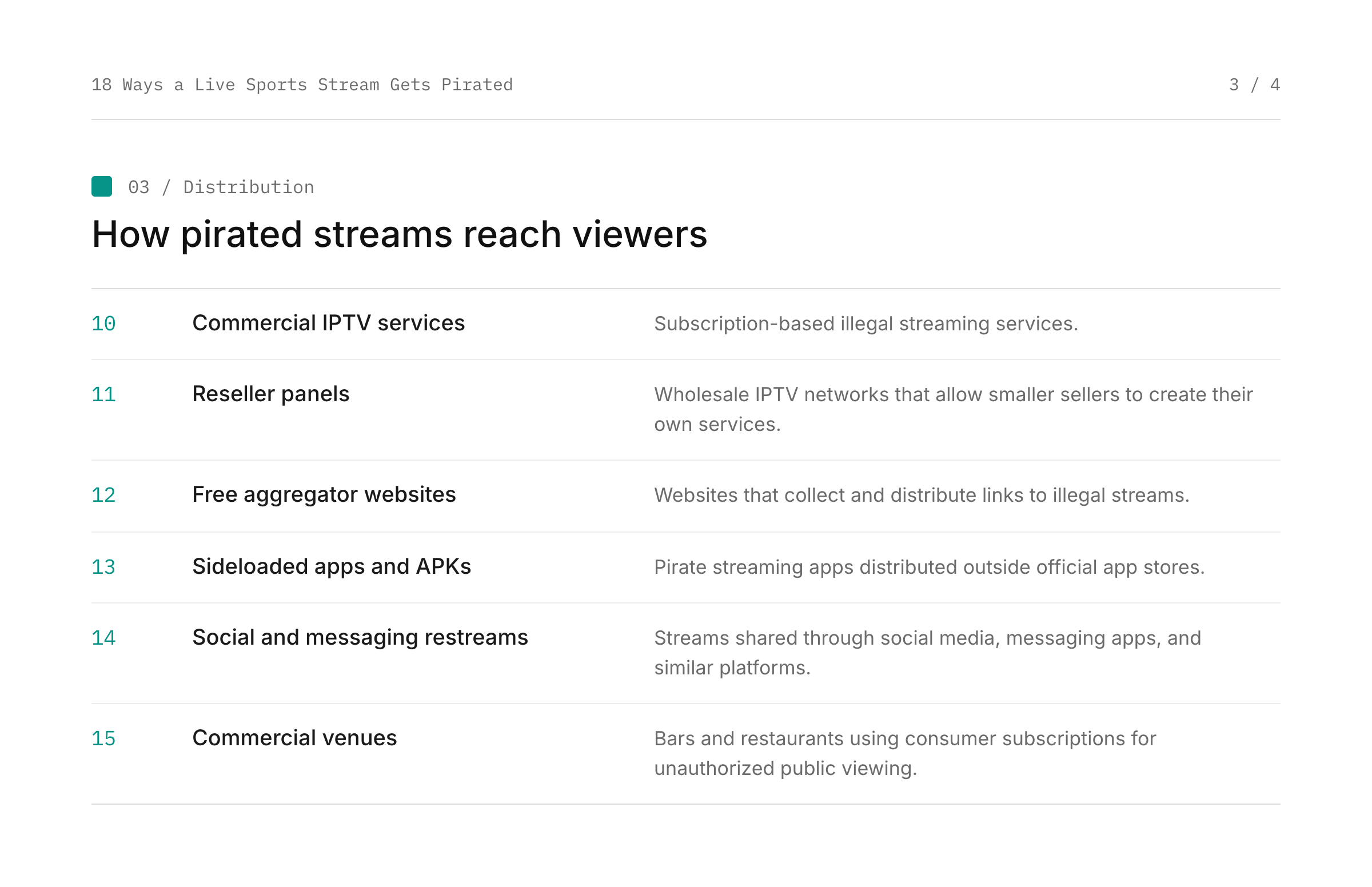
10. Commercial IPTV services
Some illegal IPTV services operate much like legitimate streaming businesses.
They can offer electronic programme guides, catch-up television, apps and even customer support. One Indian network advertised more than 10,000 live channels and 25,000 on-demand titles for roughly ₹400 for three months.
How to counter it: Refer the operation for criminal investigation, disrupt its payment rails, and use forensic watermarking to trace the stream back to its source account.
11. Reseller panels
Large IPTV operators often sell access or credits to smaller resellers.
Each reseller can create its own brand and sell subscriptions directly to customers. This structure makes enforcement difficult, because shutting down one reseller does not remove the wholesale network behind it. One monitoring firm tracked more than 4,200 active reseller operations across 31 countries in a single month.
How to counter it: Use infrastructure fingerprinting to map the panel behind the resellers, rather than pursuing storefronts one at a time.
12. Free aggregator websites
Free streaming websites collect links to illegal live streams and make money through advertising.
These sites can attract enormous audiences. Streameast, one of the largest examples, reportedly received more than 1.6 billion visits in the year before it was taken down.
How to counter it: Pursue blocking at domain level rather than URL level, and push for removal from ad networks and search results.
13. Sideloaded apps and APKs
Pirated sports streams are also distributed through apps installed outside official app stores.
When one version is blocked, operators can modify, rename and release a new version. During one cricket World Cup, a rights holder had 36 IPTV-related apps removed from Google Play and iOS. Together, those apps had already passed 26 million downloads.
How to counter it: Use app attestation, seek dynamic orders that cover future variants, and file store-level takedown notices.
14. Social and messaging restreams
Illegal streams can also appear during matches on social media and messaging platforms.
These streams may appear after kick-off and disappear immediately after the match ends. Their short lifespan often makes them difficult to remove before the event is over. A related channel has emerged in India, where illegal betting platforms carry live sport inside their own apps to attract customers to unregulated wagering.
How to counter it: Register live assets with platform fingerprint-matching systems before the event, and use automated notice APIs rather than manual reporting.
15. Commercial venues
Piracy can also happen offline.
Bars and restaurants may use a normal consumer subscription to show a sporting event to a paying audience. In this case, a licence intended for personal use is being used for commercial exhibition.
How to counter it: Apply watermarking on commercial tiers, carry out on-premises audits, and enforce the terms of the commercial licence.
Stage 4. Evasion: Keeping the Pirate Stream Online
Piracy networks also need ways to stay online once blocking and takedown attempts begin. This stage is why the problem often feels unwinnable.
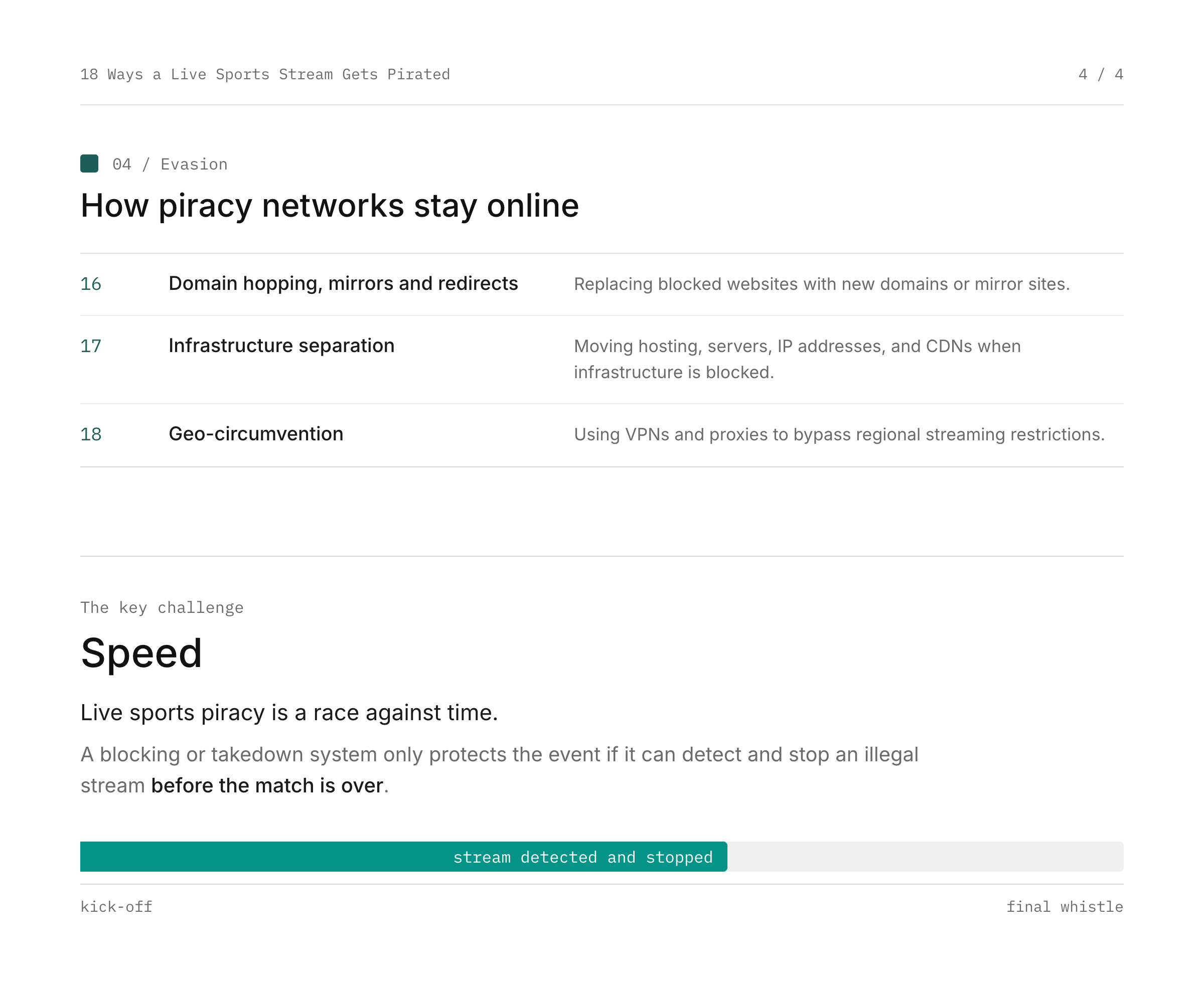
16. Domain hopping, mirrors and redirects
A blocked domain can reappear within minutes under a slightly different name, often just an alphanumeric variation of the original.
This is precisely why Indian courts moved from blocking individual URLs, to suspending entire domains, to issuing dynamic orders that cover “mirror, redirect and alphanumeric variations” automatically. By 2026, some orders allowed real-time blocking across an entire tournament and even then, roughly 458 rogue sites appeared during a single Indian Premier League season.
How to counter it: Seek dynamic orders, push for suspension at registrar level, and use predictive domain intelligence to identify variants before they go live.
17. Infrastructure separation
Hosting providers, IP addresses and content delivery networks can all be swapped once one is cut off.
Europol found that operators deliberately keep customer-facing websites apart from the servers hosting the content, and split operations across several countries so that no single jurisdiction’s order can reach the whole network.
How to counter it: Coordinate across jurisdictions, apply pressure on hosting providers, and trace the financial flows rather than only the technical ones.
18. Geo-circumvention
Viewers can use VPNs and proxies to reach a legitimate stream from a territory where they are not licensed to watch it.
This is not piracy in the sense of a stolen feed, but it does break the rights map the whole distribution model depends on. LaLiga persuaded a Spanish court to treat VPN providers as intermediaries obliged to block certain addresses during match windows.
How to counter it: Use IP intelligence to identify datacentre and VPN ranges, and enforce territory and concurrency rules at the point of playback.
Why Blocking Speed Matters
Live sports piracy is ultimately a race against time.
Indian court orders in 2026 gave internet service providers up to 36 hours to block a reported piracy site. Italy’s system requires blocking within 30 minutes. A football match typically lasts around 115 minutes, including half-time and stoppage time.
A blocking system only protects the live event if it can act before the match is over. Most of them cannot.
How Live Sports Pirates Make Money
Pirate operations are not charities, and understanding how they earn changes how you disrupt them. There are five revenue models, often stacked on top of each other.
- Subscriptions. The IPTV model. Low monthly price, enormous channel counts, real customer support. Nordic research found around 1.2 million households paying roughly €20 a month for illegal IPTV and about €280 million a year in one small region.
- Advertising. The free-aggregator model, monetised through low-quality ad networks. This is where the malware comes from: a Microsoft-documented malvertising campaign that began on illegal streaming sites reached close to a million devices.
- Gambling acquisition. In India and several other markets, illegal betting platforms now live-stream major sports inside their own apps and sponsor pirate sites elsewhere, using free sport as a customer-acquisition funnel for unregulated wagering.
- Data and fraud. Roughly 32% of users who accessed illegal streams reported direct financial losses from scams, fraud, identity theft or compromised payment details. For some operators, the stream is the bait, not the product.
- Wholesale. Piracy-as-a-service: selling infrastructure and credits to other pirates. The most resilient layer, and the one takedowns almost never reach.
This matters because it explains the resilience. Europol’s Operation KRATOS 2 dismantled nine organised crime groups across thirteen countries in seven months. The Alliance for Creativity and Entertainment took down Streameast and its 80 domains with Egyptian police. Streameast domains were reported back online roughly ten months later, before the sentences were even handed down.
Which Sports Lose the Most Revenue to Piracy?
Start with a warning, because most articles on this topic don’t give one: piracy loss estimates vary by an order of magnitude depending on methodology, and the biggest headline numbers are the least reliable.
The most-quoted figure, $28 billion a year globally, comes from a joint NFL, NBA and UFC submission to the US government.
This figure estimates potential revenue that may have been lost rather than measuring actual losses. It also relies on an assumed conversion rate from pirate viewers to paying subscribers, despite that rate never having been reliably measured. The estimate can be useful for advocacy, but it is less useful as an input for business planning.
The figures worth using are the narrower ones: specific leagues, specific markets, specific events, published with a stated scope.
Each bar is a separately published estimate with a different methodology and a different scope : a league, a whole national market, a broadcaster, or a single event. They are comparable in magnitude, not in method.
A whole market or broadcaster
Non-USD figures converted at approximate late-2026 rates for bar length only; labels show each figure as originally reported. Sources: WPI Economics, The Price of Piracy (UK); LaLiga and Serie A public statements; beIN Sports; BB Media (Latin America); Indian industry estimates for the OTT sector; press reporting on the Usyk–Fury pay-per-view.
View as a table
| Scope | Type | Reported loss |
|---|---|---|
| India OTT sector (all content) | Market | ₹8,000–11,000cr/yr |
| beIN Sports, MENA region | Broadcaster | >$1bn/yr |
| UK live sports industry | Market | £700m/yr |
| LaLiga | League | up to €700m/yr |
| Premier League | League | up to £571m/yr |
| Latin America, subscription platforms | Market | $521m/yr |
| Serie A | League | $345m/yr |
| Usyk v Fury | Single event | ~$100m |
| CONMEBOL WC qualifiers, two rounds | Two events | >$60m |
Two things jump out of that chart. First, the per-event numbers are the scariest ones. A single heavyweight title fight reportedly generated around 20 million illegal stream views and roughly $100 million in lost buys. Two rounds of World Cup qualifiers in South America cost more than $60 million. Spread those rates across a season, and the league-level figures start to look conservative rather than inflated.
Second, market-level losses dwarf league-level ones, because piracy damages the whole distribution chain: the broadcaster’s subscriptions, the league’s next rights cycle, the advertiser’s reach, and the tax base. The UK report that produced the £700 million sports figure put total economic damage from piracy across sport, film and TV at £1.35 billion a year, 10,400 fewer jobs and £366 million in lost tax.
How Piracy Affects Different Sports
Ranked by the scale and consistency of the damage rather than by any single published number, since no like-for-like league table exists.
| # | Sport | Why it is exposed | Evidence of scale |
|---|---|---|---|
| 01 | FootballPremier League, UCL, LaLiga, Serie A | Global audience, weekly fixtures, fragmented and expensive rights, and huge territory-by-territory price gaps. The single biggest volume driver in world piracy. | The gateway sport for 48% of people who admit to watching illegal streams. The 2026 Champions League final drew an estimated 3.7m unique illegal-stream IPs in the UK alone, implying ~16.2m views. LaLiga cites up to €700m; the Premier League up to £571m. |
| 02 | CricketIPL, ICC events | Enormous single-market concentration in India, very high digital rights values, and a large diaspora audience often outside the licensed territory. | India’s biggest gateway sport and the world’s second. Around 458 rogue sites detected in one IPL season. Viacom18 paid over ₹23,000 crore for IPL digital rights and the exposure is proportional. |
| 03 | Combat sportsBoxing, UFC, MMA | The pay-per-view model concentrates a whole event’s revenue into one purchase decision at $50–100. Maximum incentive to pirate, maximum damage per stream. | Worst damage per event of any sport. One heavyweight title fight: ~20m illegal views, ~$100m in lost buys. UFC and its PPV partner are estimated to lose tens of millions annually. |
| 04 | US major leaguesNFL, NBA, MLB, NHL | Extreme rights fragmentation, ten platforms and at least $765 to follow one NFL season plus local blackout rules that push fans off-platform. | ~35% of NFL fans admit to piracy. These leagues were core Streameast inventory, and jointly authored the $28bn figure. |
| 05 | MotorsportFormula 1 | A single global feed, a subscription-only model in many markets, and a technically literate audience. | Among the most commonly pirated properties after football. F1 was one of the backers of the UK piracy report, and a named rights holder in 2026 Indian blocking orders. |
| 06 | TennisGrand Slams, ATP/WTA | Long tournaments, many simultaneous courts, patchy territorial coverage and lots of matches with no legal option in a given market. | Consistently cited among the most pirated properties; named alongside F1 and the Saudi Pro League in a September 2026 Delhi High Court blocking order. |
| 07 | Everything elseRugby, WWE, Olympics, domestic leagues | Smaller audiences, but often far thinner protection budgets and for second-tier properties the revenue at risk is proportionally larger. | Italy ran a dedicated operation against a global IPTV network a week before the Milano-Cortina Winter Olympics opening ceremony. |
The pattern underneath the ranking
Piracy exposure tracks three variables almost perfectly: how globally distributed the audience is, how fragmented and expensive the legal path is, and how much value sits in a single viewing moment. Football maximises the first two. Combat sports maximise the third. Cricket in India manages all three at once, which is why it produces the most aggressive enforcement in the world.
Live Sports Piracy Around the Globe
Live sports piracy does not look the same everywhere.
In each region, it tends to grow around weaknesses in the legitimate market. For some countries, high prices push viewers toward illegal streams. In others, the problem is limited availability, fragmented subscriptions, or weak enforcement. And in one major case, piracy was linked directly to state support.
Self-reported, from a ten-market survey of more than 6,000 sports fans by Ampere Analysis for Synamedia.
Markets surveyed: Brazil, Egypt, Germany, India, Italy, Jordan, Malaysia, Saudi Arabia, UK and USA. Only 16% of online sports fans said they never watch via illegal sources.
United Kingdom: One of the Best-Measured Piracy Markets
The UK has some of the strongest data on piracy, largely because broadcasters, sports organisations and law-enforcement bodies have invested heavily in studying the problem.
The Price of Piracy, a report produced by WPI Economics in September 2026 and supported by organisations including the BBC, Premier League, Formula 1, Sky and the City of London Police, estimated that piracy across sports, film and television costs the UK economy around £1.35 billion every year. Around £700 million of that loss comes from live sports piracy alone.
The report also found that illegal streaming is surprisingly common. Around one-third of UK adults said they had used illegal streaming services within the previous three months, while around 18% had accessed live sports illegally.
Piracy was much more common among younger viewers. More than half of people aged 18–24 admitted to illegal streaming, compared with only 11% of people over 65.
The wider economic impact is also significant. The report estimated that piracy results in approximately £366 million in lost tax revenue each year, and compared that figure with the cost of thousands of NHS nurses, millions of school meals, or millions of funded childcare hours. That makes piracy more than a problem for broadcasters and sports leagues alone. (Broadband TV News · WPI Economics report)
Football is one of the biggest drivers. A survey reported by TechRadar found that around four in ten Premier League fans had watched a match through an unofficial source at least once during a season, while around 11% said they did so every week.
Modified streaming devices are also a major part of the problem. Around half of UK piracy is estimated to involve modified streaming sticks, which is one reason Sky has repeatedly called on Amazon to take stronger action against misuse of Fire TV devices.
Continental Europe: Faster Blocking, but Growing Concerns
Illegal IPTV has become one of Europe’s biggest piracy problems. Europol estimates that more than 22 million EU households subscribe to at least one illegal IPTV service.
The scale of the criminal networks behind these services became especially clear in June 2026, when European authorities carried out Operation KRATOS 2. The seven-month operation involved thirteen countries and resulted in 29 arrests, the dismantling of nine organised crime groups, the removal of more than 27,000 URLs, and the identification of hundreds of thousands of infringing items. (Brussels Times · Europol)
Some European countries have responded by introducing extremely fast blocking systems. Italy is the strongest example. Its Piracy Shield system allows illegal streaming domains and IP addresses to be blocked within 30 minutes, and by mid-2026 had reportedly blocked more than 122,000 domains and IP addresses.
The system has also attracted criticism. Because many websites share the same internet infrastructure, blocking an IP address used by a piracy service can affect legitimate websites on the same network. It also led to a €14.2 million fine against Cloudflare, whose chief executive Matthew Prince strongly criticised the approach and threatened to withdraw some of the company’s free cybersecurity support from the Milano-Cortina Winter Olympics. (Sportico)
Spain has faced similar concerns. LaLiga regularly asks Spanish internet service providers to block thousands of IP addresses during match weekends, and because some belong to shared Cloudflare infrastructure, unrelated websites have sometimes been affected. In February 2026, a court in Córdoba also classified VPN companies as “technological intermediaries” and ordered NordVPN and Proton VPN to block certain addresses during football matches. (Insider Sport · TechRadar)
The Nordic countries show a different side of the problem. Piracy there is less visible but highly organised. In spring 2026, around 1.2 million Nordic households were estimated to have access to illegal IPTV services, many paying roughly €20 per month, creating an illegal market worth around €280 million per year. (Mediavision)
India and Asia-Pacific: Cricket Drives the Piracy Problem
In India, live sports piracy is heavily driven by cricket, and the scale becomes especially visible during major tournaments such as the IPL. Ahead of IPL 2026, the Delhi High Court was told that around 458 rogue streaming websites had been detected during a previous season.
One major challenge is that pirate websites can quickly return after being blocked. When a domain is taken down, operators often create mirror sites, redirect domains, or slightly altered versions of the original address. Indian courts have increasingly used dynamic injunctions, which allow newly created mirror or redirect sites to be blocked without requiring rights holders to begin the entire legal process again.
During a FIFA World Cup case in June 2026, Justice Saurabh Banerjee highlighted how easily piracy operators can create new mirror and redirect websites to bypass previous blocking orders. Earlier in the year, while ordering the blocking of 79 domains linked to illegal UEFA Champions League streaming, Justice Jyoti Singh said piracy needed to be dealt with “with a heavy hand.” (24Law · Medianama)
Across the wider Asia-Pacific region, piracy remains widespread. Research from the Asia Video Industry Association placed piracy consumption across the region at around 59% in 2024, with particularly high levels reported in countries such as Vietnam and the Philippines.
There is also a major cybersecurity risk. Research into illegal streaming apps found that many contained malware capable of stealing personal information or turning infected devices into part of a botnet. The risk to viewers goes beyond copyright infringement: using illegal streaming services can expose devices, passwords, payment details and personal data. (AVIA · WIPO Magazine)
Latin America: Extremely High Piracy Penetration
Piracy is deeply established across Latin America. Around 28% of connected households in the region are estimated to access pirated content, and some countries report much higher levels, Ecuador at around 65% household penetration, while Brazil is closer to 31%.
Unlike some other regions, piracy in Latin America relies heavily on streaming websites and M3U playlists rather than traditional torrent downloads. Websites account for around 64% of piracy access, while M3U playlists account for roughly 57%.
The financial losses are significant. Subscription video platforms are estimated to lose more than $521 million per year across the region, and even individual sporting events generate large losses, two rounds of CONMEBOL World Cup qualifiers were estimated to have caused more than $60 million. (Media Play News · ACE)
Brazil has responded with one of the region’s most sustained anti-piracy programmes: Operation 404. Named after the familiar “404 Not Found” internet error, the operation targets illegal websites, applications and streaming services. Its latest phase blocked 535 websites and involved 42 search-and-seizure warrants, with authorities from Argentina, Ecuador, Paraguay, Peru and the UK taking part. The Premier League became the first sports organisation to participate directly in the operation, in 2023. (Premier League · Advanced Television)
Middle East and North Africa: When Piracy Became a State-Level Dispute
The Middle East produced one of the most unusual sports piracy cases ever recorded. Between 2017 and 2019, a ten-channel piracy service called beoutQ illegally broadcast some of the world’s biggest sporting events, including the Super Bowl, the Champions League final, the NBA Finals, Formula 1 races and all 64 matches of the 2018 FIFA World Cup.
The case became much bigger than a normal piracy dispute. In 2020, a World Trade Organization panel found that Saudi authorities had failed to take sufficient action against the operation and that elements of the Saudi state had supported or promoted beoutQ. The WTO also found Saudi Arabia in breach of several obligations under the TRIPS Agreement.
The dispute showed what sports piracy can look like when it becomes connected to international politics and trade. beIN Sports has cited annual piracy-related losses of more than $1 billion in the region. (Al Jazeera · ESPN)
The case was eventually addressed through international trade proceedings rather than normal copyright enforcement. By that point, however, many of the sporting events involved had already taken place, which highlights one of the biggest challenges of live sports piracy: legal remedies often move much more slowly than the content itself.
Sub-Saharan Africa: A Large but Underreported Market
Sports piracy in Africa receives far less international coverage than piracy in Europe or North America. That does not mean the problem is small.
MultiChoice, now owned by Canal+, has carried out raids and enforcement actions across South Africa, targeting syndicates that illegally redistribute DStv channels. Some illegal services reportedly resell premium television packages for as little as R85.
Authorities and broadcasters have responded with a combination of physical raids, arrests, prosecutions, ISP blocking and technical tools such as forensic watermarking. MultiChoice has also pushed regulators to introduce stronger legal powers for fighting piracy. (TechCentral · BusinessTech · ITWeb)
North America: When Streaming Fragmentation Becomes Part of the Problem
The United States has a different challenge. Sports are increasingly spread across multiple streaming platforms, cable networks and league-specific services, and for fans, simply finding where a particular match is available can be difficult.
Research from Bango published in August 2026 found that 46% of sports fans had experienced problems discovering where games were available, and some said they had missed games because they could not find the correct streaming service. Around 30% of respondents said they believed piracy was the best way to stream sports.
That does not justify piracy, but it does show how streaming fragmentation influences viewer behaviour. The cost of following several major US leagues can also become very high: watching every NFL, NBA and MLB game across a season has been estimated at around $2,621, spread across ten or more services. (MediaPost)
The issue has become significant enough to attract regulatory attention. In February 2026, the US Federal Communications Commission opened an inquiry into the movement of major sports rights from free broadcast television toward subscription streaming platforms. The inquiry received close to 9,000 public comments. (Deadline · Sportico)
At the same time, enforcement has increased. During the 2026 FIFA World Cup, the US Department of Justice carried out Operation Offsides, which resulted in the seizure of more than 1,000 domains accused of illegally streaming tournament matches. (U.S. Department of Justice)
What the global picture tells us
The UK has some of the strongest piracy data in the world, and still loses hundreds of millions of pounds. Italy has the fastest blocking system anywhere, and a constitutional challenge to go with it. India has the most inventive courts, and pirate operators still create mirror domains within minutes. The US runs the largest domain seizures, and has the highest self-reported piracy rate of any major market.
Different countries are using different approaches, but no market has solved live sports piracy because live sport moves faster than traditional enforcement. By the time a site is identified, reported, reviewed and blocked, much of the value of the event is already gone.
Why Sports Fans Turn to Pirate Streams
The most important finding in the research is also the most awkward: 89% of sports fans who pirate already pay for a legitimate service.
This is not a population that refuses to pay. It is a population that pays and still can’t watch the game. The Synamedia and Ampere study of more than 6,000 fans across ten markets found that 51% watch pirate sports content at least monthly, and only 16% say they never do. Among regular pirate viewers, 42% watch sport daily, well above the average fan. These are the most engaged customers in the market.
The stated reasons are practical rather than ideological. 31% of regular illegal viewers say they do it because the event they want isn’t shown where they live. The rest of the picture is about cost and friction:
- A committed fan now needs four to six premium subscriptions, often exceeding the cost of the cable package they cancelled a decade ago.
- Following one NFL season required ten platforms and at least $765.
- 46% of Americans have missed a game because they couldn’t work out where it was streaming. Ahead of the 2026 World Cup, 41% didn’t know where to watch it.
- Pirate products often offer a single interface, no region locks and no ads, a genuinely better user experience than the legitimate alternative.
None of that makes piracy legal or harmless. But it does mean that any strategy built purely on blocking is fighting demand created by the rights market itself.
The Hidden Risks of Illegal Sports Streams
The “victimless” framing collapses on the evidence. Visits to piracy sites carry a malware risk estimated at up to 65 times that of legitimate sites. A study of illicit streaming apps across Asia-Pacific found nearly half contained malware capable of harvesting personal data and enrolling devices into botnets. In the UK, roughly 3.6 million illegal streamers reported viruses, fraud or data theft, and around 32% of illegal-stream users globally reported a direct financial loss.
And the supply side is organised crime. Europol’s position is blunt: what looks to a consumer like cheap access to premium content is powered by criminal enterprises that also run money laundering and fraud operations.
The Wider Economic Cost of Sports Piracy
There is also a slower, structural cost. Media rights values are set by what a broadcaster believes it can monetise. When a meaningful share of the audience is unmonetised, the next rights cycle prices that in. Analysts already expect IPL media rights to plateau around $5.4 billion in the 2028–32 cycle after years of steep growth. Piracy is not the only reason for a plateau, but it is one of the inputs and it compounds, because a devalued rights cycle means less money for protection in the cycle after that.
How Live Sports Piracy Is Being Fought
Three tracks, running in parallel, with very different speeds.
1. Real-time site and domain blocking
Courts now issue “dynamic” injunctions that extend automatically to mirrors, redirects and app variants without a fresh hearing. India’s Delhi High Court has gone furthest, allowing rights holders to notify internet providers and domain registrars directly during a tournament. Italy went the statutory route, mandating blocking within 30 minutes and drew a constitutional challenge and a €14.2 million fine against Cloudflare in the process.
2. Criminal enforcement against piracy networks
Europol’s Operation KRATOS 2 produced 29 arrests and dismantled nine organised crime groups across thirteen countries. The US Department of Justice’s Operation Offsides seized more than 1,000 domains during the 2026 World Cup. Indian police have arrested IPTV operators and frozen their proceeds. These operations are genuinely effective as deterrence and they resolve over months, not minutes.
3. Preventing piracy inside the stream
This is the only track that executes inside the match. Everything else depends on a third party acting: a judge, a registrar, an internet provider, a foreign police force. The controls below run on infrastructure the rights holder already owns.
| Control | What it stops |
|---|---|
| Multi-DRMWidevine · PlayReady · FairPlay | Key extraction, segment interception and DRM downgrade attacks. Hardware-backed keys with short rotation make an intercepted segment worthless. |
| Forensic watermarking | Insider leaks, licensee re-export, screen capture and venue piracy. Embeds a session-unique invisible mark so a leaked stream resolves to a specific account, the only control that lets you kill a leak mid-match. |
| Token and URL authentication | CDN leeching. Short-lived, single-use, session-bound playback URLs stop stolen links from working for anyone else. |
| Geo and IP restriction | Out-of-territory access and VPN circumvention. Enforces the rights map in software instead of in court. |
| Concurrency and device limits | Credential sharing and account resale, the highest-volume vector nobody litigates. |
| Real-time monitoring | Bot-driven logins, impossible-travel sessions and abnormal request patterns, flagged during the event rather than in a post-match report. |
| Dynamic on-screen watermark | Casual restreaming. A moving viewer identifier that cannot be cropped out makes the act personally traceable. |
| Low-latency delivery | An underrated one. Pirate restreams run seconds to minutes behind. Closing your own latency gap makes the legitimate stream the faster product, which matters enormously to anyone following a live result. |
Building this into a live stream
VdoCipher delivers these as one stack for live and on-demand video: multi-DRM encryption with hardware-backed keys, dynamic watermarking, token-authenticated encrypted HLS delivery, IP and geo restriction and concurrency controls, with live streaming built on the same protections. If you are scoping protection for an event, start with the secure streaming app security checklist and why DRM alone is not enough.
What This Means for Broadcasters and Rights Holders
Live sports piracy is not one problem with one fix. It is an acquisition problem at the source, an infrastructure problem in the middle, a distribution problem at the edge, and a demand problem in the living room. The sports that lose the most are precisely the ones combining a global audience with a fragmented, expensive legal path: football on total volume, combat sports per event, and cricket in India, which manages both at once.
The enforcement response has never been stronger than it is now. Courts issue dynamic injunctions that extend automatically to mirrors and variants. Europol dismantled nine criminal networks in seven months. The United States seized more than a thousand domains during a single tournament. Police in India have made arrests and frozen the proceeds.
And none of it moves at the speed of a live match. Pirates can bring a blocked domain back online within minutes. A 36-hour compliance window lasts longer than every football match it is meant to protect. Streameast returned online before courts sentenced its operators. Enforcement can deter piracy and help clean up its aftermath, but authorities never designed it to provide real-time defence. When rights holders treat it that way, they end up facing the same surprises every season.
That leads to a straightforward conclusion. Only measures built directly into the stream can act within the ninety-minute window that matters: encryption can make intercepted segments worthless, forensic watermarking can identify the leaking account before half-time, expiring playback tokens can stop users from sharing access, software can enforce territory restrictions without waiting for a court order, and concurrency limits can ensure that one subscription behaves like one subscription.
Pursue the injunction. It is worth having, and it is the only thing that removes a pirate operation permanently. Just don’t mistake it for the defence.
Frequently Asked Questions About Live Sports Piracy
What is live sports piracy?
Live sports piracy is the unauthorised capture and redistribution of a sporting event while it is being broadcast. It includes illegal IPTV subscription services, rogue streaming websites, restreams on social platforms, tampered set-top boxes and shared or stolen credentials. It differs from film piracy because a live match loses almost all of its commercial value once it ends, so remedies awarded after the fact protect very little.
Which sport loses the most revenue to piracy?
Football, by total volume. It is the gateway sport for 48% of people who admit to watching illegal streams, and individual leagues report annual losses of up to €700 million (LaLiga) and £571 million (Premier League). Cricket is second globally and first in India. Combat sports suffer the worst damage per event, one heavyweight title fight reportedly drew around 20 million illegal views and $100 million in lost pay-per-view buys.
How much does live sports piracy cost the industry each year?
The most-quoted figure is $28 billion a year globally, from a joint NFL, NBA and UFC submission, but that estimates foregone potential revenue rather than observed loss. More defensible narrower figures include £700 million a year for the UK live sports industry, $521 million a year on Latin American subscription platforms, and more than $1 billion a year cited by beIN Sports in the MENA region.
How do pirates get hold of a live sports stream?
There are several routes. Pirates intercept the contribution feed between venue and playout; tamper with legitimate set-top boxes and rebroadcast the decoded output; extract stream URLs and access tokens from a legitimate app, known as CDN leeching; force playback onto a weaker software DRM level and capture the decrypted stream; use shared, resold or brute-forced credentials; or simply point a capture device at a licensed screen.
Why can’t broadcasters stop illegal streams during a live match?
Because takedown depends on third parties acting, and every step costs time the match does not have. Domain registrars suspend domains, internet providers block access, and government departments issue notifications. Indian court orders in 2026 allowed internet service providers up to 36 hours to comply, while a football match lasts around 115 minutes. Meanwhile blocked domains reappear as new variants within minutes.
Do people who pirate sport already pay for legitimate subscriptions?
Yes, in most cases. Research across ten markets found that 89% of sports fans who watch pirated content already hold a pay-TV or subscription streaming service, and 51% of all sports fans watch pirated sport at least once a month. The most common stated reason, given by 31% of regular illegal viewers, is that the event they want is not shown where they live.
Is watching an illegal sports stream dangerous?
Measurably so. Piracy sites carry an estimated malware risk up to 65 times that of legitimate sites, and a study of illicit streaming apps across Asia-Pacific found nearly half contained malware capable of harvesting personal data and enrolling devices into botnets. Around 32% of illegal-stream users report a direct financial loss from fraud, scams or identity theft.
How can broadcasters and rights holders prevent live sports piracy?
Effective protection layers controls that execute inside the live window rather than after it: hardware-backed multi-DRM with short key rotation, session-level forensic watermarking to trace any leak back to its source account, short-lived token-authenticated playback URLs to stop CDN leeching, geo and IP restriction to enforce the rights map, concurrency and device limits to curb credential sharing, and real-time monitoring to detect abnormal access while the event is still live.
Supercharge Your Business with Videos
At VdoCipher we maintain the strongest content protection for videos. We also deliver the best viewer experience with brand friendly customisations. We'd love to hear from you, and help boost your video streaming business.


Rahul Rana is Head of Marketing at VdoCipher Media Solutions, where he educates users about video streaming and media technologies. He writes about video streaming, live delivery, DRM, and building custom video players to help developers and teams learn practical techniques. Rahul enjoys breaking down complex media tech into clear, easy-to-understand guides and insights.
Leave a Reply