
Funeral live streaming enables families and communities to participate in memorial services even when physical attendance is not possible. Today, funeral live stream is typically managed by funeral homes and service providers rather than families themselves, requiring a level of technical reliability and privacy that public platforms cannot offer. In this article, we look at how organizations deliver funeral live streaming professionally, with a strong emphasis on secure access, dignified viewing, and controlled post-ceremony playback.
Table of Contents:
- What is Funeral Live Streaming?
- Common Reasons Why People Need Live Streaming Services for Funerals
- Who Typically Offers Funeral Live Streaming Services
- Technical Requirements for Funeral Live Streaming
- Privacy, Security & Ethical Considerations
- Legal & Consent Considerations
- Live vs Recorded Access After the Funeral Ceremony
- DVR-Based Replay for Missed Live Moments
- How VdoCipher Live Enables Secure & Dignified Funeral Live Streaming
- FAQs
What is Funeral Live Streaming?
Funeral live streaming is a professionally managed video broadcast of a funeral or memorial service, delivered securely over the internet to authorized viewers in real time.
In an organizational context, this service is not handled by the grieving family, but by funeral homes, religious institutions, or event service providers who manage the entire streaming workflow on their behalf, from capture and transmission to access control and post-event availability.
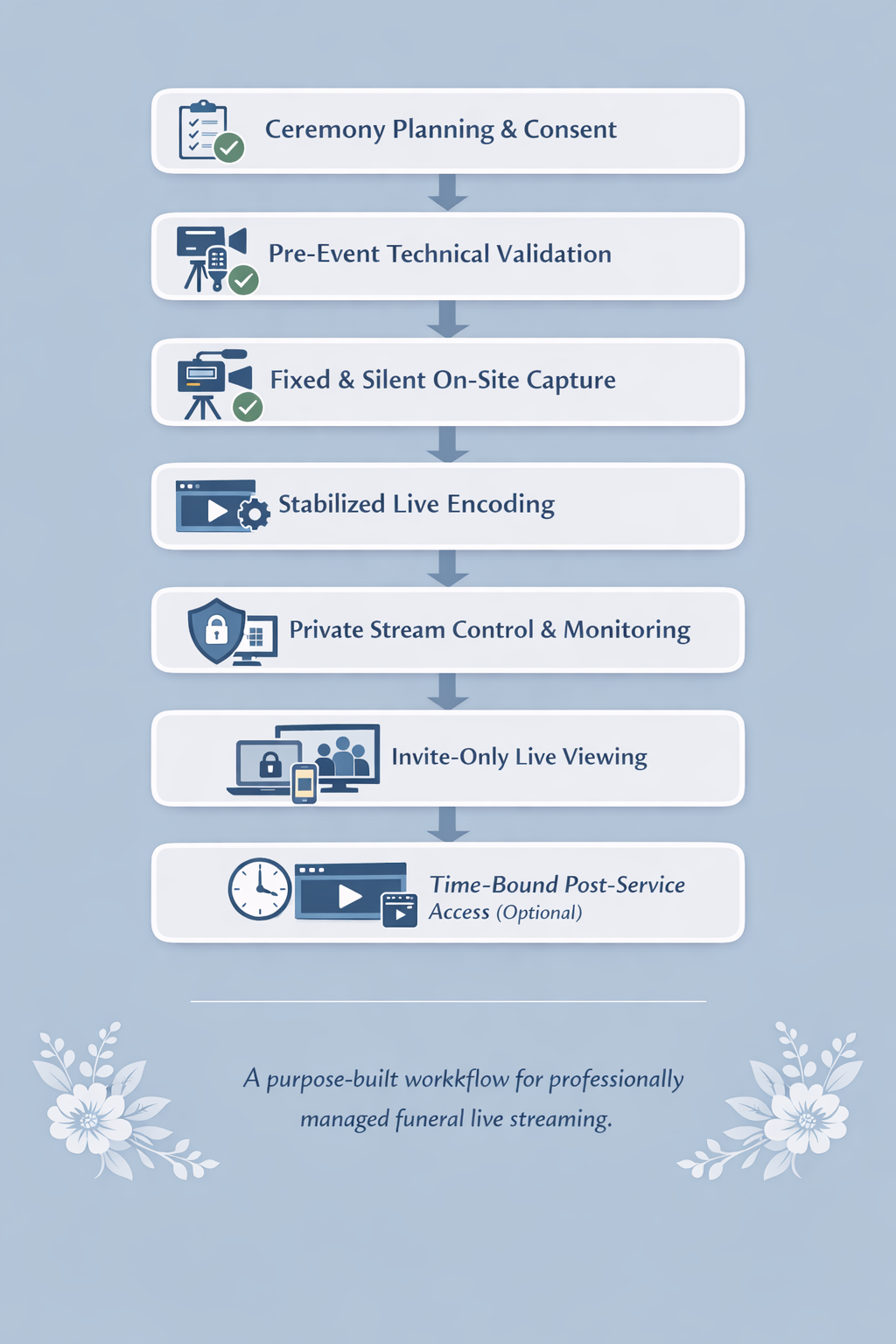
At its core, funeral live streaming involves:
- Capturing the ceremony using dedicated cameras and audio equipment
- Encoding and transmitting the live feed through a streaming platform
- Delivering the stream privately to invited attendees across locations and devices
- Optionally recording the service for controlled, time-bound replay access
Unlike casual live streaming on public platforms, funeral live streaming prioritizes privacy, reliability, and dignity. Streams are typically restricted, invitation-only, free from advertisements or public interactions, and designed to operate seamlessly without disrupting the ceremony.
For organizations, funeral live stream functions as a value-added professional service, one that must meet high standards of technical stability, ethical responsibility, and presentation quality. The success of the stream directly reflects on the service provider’s credibility, making secure infrastructure and controlled delivery essential components of the offering.
Common Reasons Why People Need Live Streaming Services for Funerals
The need for funeral live streaming typically arises from practical and situational constraints, rather than convenience or preference. Families request this service when physical attendance is not possible for all those who wish to be present, and when the ceremony still needs to remain private and dignified.
One of the most common reasons is geographical distance. Families today are often spread across cities and countries, and international travel may not be feasible on short notice. Live streaming allows relatives and close acquaintances to witness the ceremony in real time, despite being physically distant.
Health and mobility limitations are another major factor. Elderly family members, individuals with medical conditions, or those advised against travel may be unable to attend in person. Live streaming enables participation without exposing them to physical strain or risk.
In many cases, venue capacity limitations also play a role. Funeral venues, religious halls, or cremation grounds may have restricted seating or attendance limits. Live streaming helps extend access beyond the physical space while maintaining order at the venue.
There are also situations involving professional or legal constraints, such as:
- Individuals unable to travel due to work obligations
- Visa restrictions or lack of travel permissions
- Military or government-related limitations
Additionally, families may request live streaming to ensure that close friends, extended relatives, or community members can observe the ceremony respectfully without overcrowding the venue.
Importantly, live streaming is often chosen to maintain privacy while expanding access. Rather than opening the ceremony to the public or recording it informally, families prefer a controlled, managed broadcast that allows attendance without compromising the solemn nature of the occasion.
For service providers, understanding these reasons helps frame funeral live streaming not as a technical feature, but as a supportive extension of the funeral service itself, designed to accommodate real-world constraints while preserving dignity and respect.
Who Typically Offers Funeral Live Streaming Services
Funeral live streaming is usually provided by organizations that manage funeral and memorial services, rather than by families themselves. These providers are responsible for ensuring the ceremony is streamed professionally, securely, and without disruption.
Funeral homes and crematoriums are the most common providers, often offering live streaming as a value-added service through in-house setups or professional streaming platforms. Religious institutions, including churches, temples, mosques, and prayer halls, also frequently offer live streaming, supported by their existing audio-visual infrastructure and familiarity with ceremonial practices.
In addition, memorial parks, cemetery operators, and professional event or AV service providers may manage funeral live streams, particularly when attendance is restricted or when technical expertise is required. In some cases, municipal or defense organizations arrange live streaming for official or military funerals.
Across all these providers, the goal remains the same: to deliver a private, reliable, and unobtrusive live stream that preserves the dignity of the ceremony and protects the family’s privacy.
Technical Requirements for Funeral Live Streaming
Funeral live streaming requires a stable, discreet, and professionally managed setup that operates reliably without drawing attention or interrupting the ceremony. Since the event cannot be repeated, organizations must plan for consistency, privacy, and fail-safe operation rather than experimentation.
At a minimum, the technical setup must ensure clear audio, stable video, uninterrupted connectivity, and controlled access for invited viewers.
Camera Setup
Professional funeral live streams rely on fixed, tripod-mounted or installed cameras to avoid movement and visual distraction. Most services use either:
- A single wide-angle camera for full coverage, or
- Multiple static cameras for speakers, rituals, and congregation
- Camera movement during the ceremony is typically avoided to maintain dignity and visual calm.
Audio Capture
Audio clarity is often more important than video resolution. Professional setups use:
- Dedicated microphones or direct feeds from the venue’s sound system
- Careful balancing of spoken words, prayers, and ambient sound
- Echo and noise management, especially in large halls or outdoor venues
Poor audio is the most common cause of dissatisfaction in funeral streams.
Live Encoder & Streaming Workflow
Organizations generally use a software or hardware encoder to send the live feed to a streaming platform instead of relying on basic “go live” tools. This enables:
- Better stream stability
- Controlled video quality
- Real-time monitoring during the service
The complete workflow should be tested before the ceremony to eliminate last-minute issues.
Internet Connectivity & Redundancy
A reliable upload connection is mandatory. Best practices include:
- Wired broadband as the primary connection
- Mobile or secondary network as backup
- Pre-event bandwidth testing
The stream should automatically adapt to different viewer network conditions to prevent buffering or drop-offs.
Secure Delivery & Access Control
Funeral live streams are private by nature. The technical setup must support:
- Restricted or invite-only access
- Non-public playback links
- Controlled viewing windows
This ensures the ceremony remains dignified and is not exposed on public platforms.
Monitoring & Fail-Safe Handling
During the ceremony, the stream should be actively monitored for Audio levels, Video continuity, and Network health.
Fail-safe measures such as backup connections or quick source switching help maintain uninterrupted delivery.
Privacy, Security & Ethical Considerations
Funeral live streaming involves deeply personal moments, making privacy, security, and respectful handling essential to how the service is delivered. For organizations providing this service, the goal is not reach or visibility, but controlled access and protected viewing.
When offering funeral live streaming, organizations should ensure the following are in place:
- Private-by-default streams with no public discovery or indexing
- Restricted viewer access for invited attendees only
- Secure delivery of live streams to prevent interception or misuse
- Protected recordings, if enabled, with no open downloads
- Limited access duration for post-service viewing
- Controls to discourage unauthorized recording or resharing
- Ad-free, distraction-free viewing environment
- Ability to disable or revoke access when the service concludes
Legal & Consent Considerations
Funeral live streaming involves recording and transmitting a real-world ceremony, which introduces legal and consent-related responsibilities for the organizations managing the service. These considerations vary by region, but the underlying principles remain consistent across jurisdictions.
Before offering or enabling funeral live streaming, organizations should ensure:
- Explicit authorization from the immediate family to live stream the ceremony
- Clarity on recording permissions, including whether post-service playback is allowed
- Awareness of participants being recorded, including speakers and officiants
- Compliance with local recording and broadcasting laws
- Defined access scope (who can view the stream and recording)
- Clear retention and deletion timelines for recorded content
- Avoidance of platforms with conflicting or implicit content rights
- Internal documentation or SOPs covering funeral live streaming procedures
Live vs Recorded Access After the Funeral Ceremony
When an invited attendee misses the live funeral stream, organizations typically offer one of two access models. Each option serves a different family preference and requires different levels of control.
| Aspect | Live-Only Access | Live + Recorded Access (Live-to-VOD) |
| Availability | Only during the ceremony | Live viewing plus limited replay |
| Post-Ceremony Access | Not available | Enabled for a defined period |
| Viewer Scope | Invited viewers only | Same invited viewers only |
| Playback Control | Stream ends when ceremony ends | Controlled playback via secure video player |
| Download Permission | Not applicable | Disabled (streaming only) |
| Access Duration | Real-time only | Time-bound (e.g., 24 hours, 7 days, 30 days) |
| Privacy Level | Maximum | High, with enforced access controls |
| Operational Use Case | Families wanting no digital footprint | Families wanting flexibility for missed viewers |
How Recorded Access Is Typically Implemented
When recorded access is enabled, the live stream is automatically converted into a secure on-demand video after the ceremony. This Live-to-VOD workflow allows organizations to:
- Offer replay access without reprocessing or re-uploading
- Enforce access expiry and viewer restrictions
- Prevent downloads or uncontrolled redistribution
- Disable playback entirely once the access window closes
This ensures recorded access remains a temporary extension of the live service, not a permanent archive.
DVR-Based Replay for Missed Live Moments
For funeral live streaming, timing matters but real-world constraints mean some attendees may join late or miss parts of the ceremony. This is where a DVR-enabled live streaming experience becomes valuable.
With DVR functionality, viewers can pause, rewind, or resume the live stream while the ceremony is still in progress. This allows late joiners to watch important moments from the beginning or revisit specific segments without waiting for the service to end.
From an organizational perspective, DVR-based streaming offers several advantages:
- Viewers can catch up discreetly without disrupting the ceremony
- There is no need to create or share separate recordings mid-event
- The live stream remains private and access-controlled
- Playback stays within the same secure viewing environment
Unlike public platforms, DVR playback operates within a secure live stream session, ensuring that rewind and replay access is still subject to the same restrictions as the live broadcast.
After the ceremony concludes, the same stream can optionally transition into a secure Live-to-VOD experience, where replay access remains available for a defined period before being disabled.
Why DVR Matters for Funeral Live Streaming Services
DVR functionality helps organizations offer a more flexible and considerate viewing experience without expanding access beyond what the family has approved. It supports missed moments while preserving privacy, dignity, and control, making it especially suited for sensitive, one-time ceremonies.
For funeral live streaming, recorded access, when provided, should be secure, time-limited, and access-controlled. VdoCipher Live offers Live-to-VOD workflows that allow organizations to support viewers who miss the ceremony without compromising privacy or long-term control.
How VdoCipher Live Enables Secure & Dignified Funeral Live Streaming
Funeral live streaming places unique demands on the streaming infrastructure, privacy, reliability, and controlled access are non-negotiable. VdoCipher Live is designed to meet these requirements at an organizational level, making it well suited for funeral homes, religious institutions, and memorial service providers.
Private, Access-Controlled Live Streams
VdoCipher Live allows organizations to stream funerals in a private-by-default environment. Streams are not publicly discoverable and can be restricted to authorized viewers only. Access can be managed through controlled links or authentication, ensuring the ceremony is visible only to the intended audience.
Encrypted Video Delivery
All streams on VdoCipher are delivered using secure, encrypted video pipelines, protecting the stream during transmission and playback. This significantly reduces the risk of interception, unauthorized access, or misuse, a critical requirement for sensitive ceremonies.
DVR for Live Funeral Streams
VdoCipher Live includes DVR functionality, allowing viewers to pause, rewind, or catch up on missed moments while the ceremony is still in progress. This is especially helpful for attendees joining late, without requiring separate recordings or disrupting the live service.
Live-to-VOD With Full Control
Once the ceremony concludes, the same live stream can seamlessly transition into a secure on-demand video. Organizations can:
- Enable or disable replay access
- Set time-bound availability
- Prevent downloads or permanent storage
This Live-to-VOD workflow supports missed viewers while maintaining full control over post-event access.
White-Label, Distraction-Free Playback
VdoCipher Live provides a clean, white-label video player with no ads, recommendations, or public interactions. This ensures the viewing experience remains focused, respectful, and appropriate for a funeral setting.
Deterrence Against Unauthorized Recording
VdoCipher recorded playback supports playback controls and watermarking options that discourage unauthorized recording or resharing. These measures help reinforce that the stream is private and intended for respectful viewing only.
Built for Professional, Repeat Use
Unlike social platforms designed for casual streaming, VdoCipher Live is built for organizations managing recurring live events. It offers:
- Consistent performance
- Centralized stream management
- Scalable delivery for remote attendees
This allows funeral live streaming to be offered as a reliable, repeatable professional service.
FAQs
Is funeral live streaming private or public by default?
Professional funeral live streaming is typically private by default. Secure platforms like VdoCipher Live restrict access to invited viewers only and avoid public discovery, ads, or recommendations.
Can we control who can watch the funeral live stream?
Yes. Organizations can restrict access to authorized attendees only, revoke access at any time, and prevent links from being reused or shared beyond the intended audience.
Can viewers rewind or pause during the live ceremony?
With DVR-enabled live streaming, viewers can pause, rewind, or catch up on missed moments while the ceremony is still ongoing, without disrupting the live service or waiting for it to end.
Is social media suitable for funeral live streaming?
Social media platforms are designed for public engagement and discovery. For funerals, secure video platforms are better suited because they offer privacy, access control, no ads, and respectful viewing environments.
Is funeral live streaming compliant with privacy expectations?
When handled by professional providers using secure platforms, funeral live streaming can be delivered in a way that respects privacy, dignity, and ethical boundaries, provided proper authorization and controls are in place.
Supercharge Your Business with Videos
At VdoCipher we maintain the strongest content protection for videos. We also deliver the best viewer experience with brand friendly customisations. We'd love to hear from you, and help boost your video streaming business.

Jyoti began her career as a software engineer in HCL with UNHCR as a client. She started evolving her technical and marketing skills to become a full-time Content Marketer at VdoCipher.
Leave a Reply